


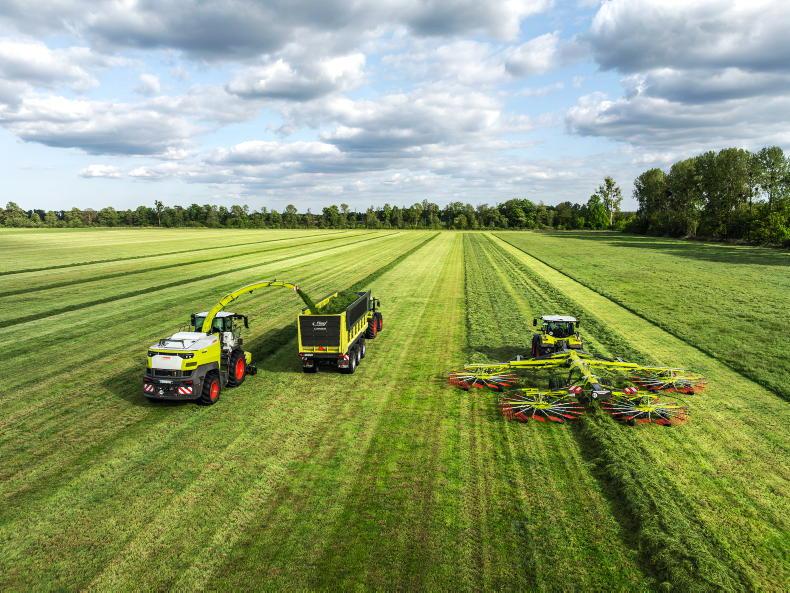
As we go to print on Tuesday afternoon, a new Claas Jaguar 1090 forager is being readied to leave the Claas factory in Harsewinkil, Germany. From here it will travel to the Netherlands, where it will have its tyres fitted, before being shipped for PDI at Kellys of Borris in Carlow. All going to plan, the machine will be chopping grass in Kilkenny on Wednesday 29 April, at Grass 2026.
After several years of development, Claas unveiled the new four-model flagship forage harvester last autumn, spanning from 850 to 1,110hp engine power.
Claiming to have the widest crop flow on the market, it says the new series enables throughput capacities of up to 480t/hour.
The Jaguar 1080, 1090, 1100 and 1200 are powered by a transverse-mounted 24l MAN V12 engine.
Claas explains that the drive concept has been integrated into the overall design concept to save space, resulting in an identical external width to the Jaguar 800 and 900.
Claas says the new series has been based on many years of development and practical testing, which have resulted in a series that’s more than just its engine power.
The new features include the self-acclaimed widest crop flow on the market, fully hydraulic pre-compression, homogeneous chop quality, the large corn cracker, the drive concept with two independent variable front attachment drives, new pick-up and Orbis front attachments, driver assistance systems, the new Nutrimeter and an updated chassis.
JCB
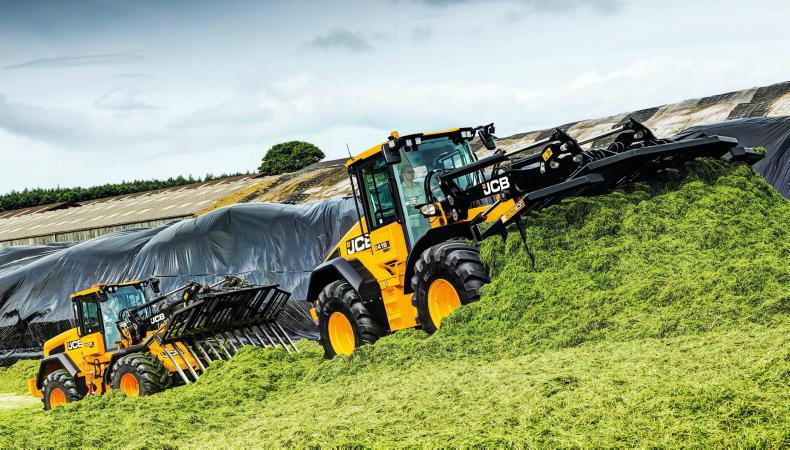
On the pit demonstration, Kilkenny Agri will showcase JCB’s new 435S wheel loader, which recently gained more engine power and torque, which was complemented by uprated driveline components. JCB’s 435S was first introduced in 2014, it was revamped in 2016.
In 2020, the 435S went to Stage V, kept the original cosmetic design, but moved from 230hp to 252hp and is known to operators as the red S machine. The new version of JCB’s purpose-built agricultural wheeled loader has 12% more engine power, increased from 252hp to 282hp, which takes the machine’s power-to-weight ratio from 17hp/t to 19hp/t.
JCB claims this is 26% more than the closest competitor machine. Its performance has also been tweaked, thanks to an increase in torque at all engine speeds, with maximum output of 1,200Nm generated across a wider range of engine rpm to help maintain performance under increasing load.
With this, JCB has stuck with the reliable Cummins 6.7l engine in the 435S, available with two power settings: 230hp with peak torque of 840Nm is the default setting, which provides sufficient power for road travel and lighter loading or re-handling, with the advantage of reduced fuel consumption.
For maximum performance such as on a silage pit, the operator can switch to Dynamic mode and release up to 282hp for more challenging tasks.
In addition to the 12% increase in peak power, the latest engine delivers more power across a rev range from 1,500-2,200rpm. This is complemented by increased torque across the board and a torque curve that maintains the maximum 1,200Nm output all the way from 1,600-down to 1,100rpm as engine revs are pulled down under increasing load. As a result, operators are able to achieve the same class-leading performance at much lower engine rpm.
To handle the power and torque increases, the driveline has received a major upgrade, which JCB says is capable of handling 34% more torque than the previous model.
The new axles feature heavier-duty final drive assemblies and a new torque converter that in “open” mode can deliver up to 25% more torque to the wheels, resulting in greater tractive effort for silage clamp work.
To handle the additional power and torque, new axles with final drive units containing four rather than three epicyclic gears are fitted.



SHARING OPTIONS